Ads Manager is a foreign language pretending to be a dashboard. Here's a translation for the words that actually matter, and permission to ignore the rest.
CPM
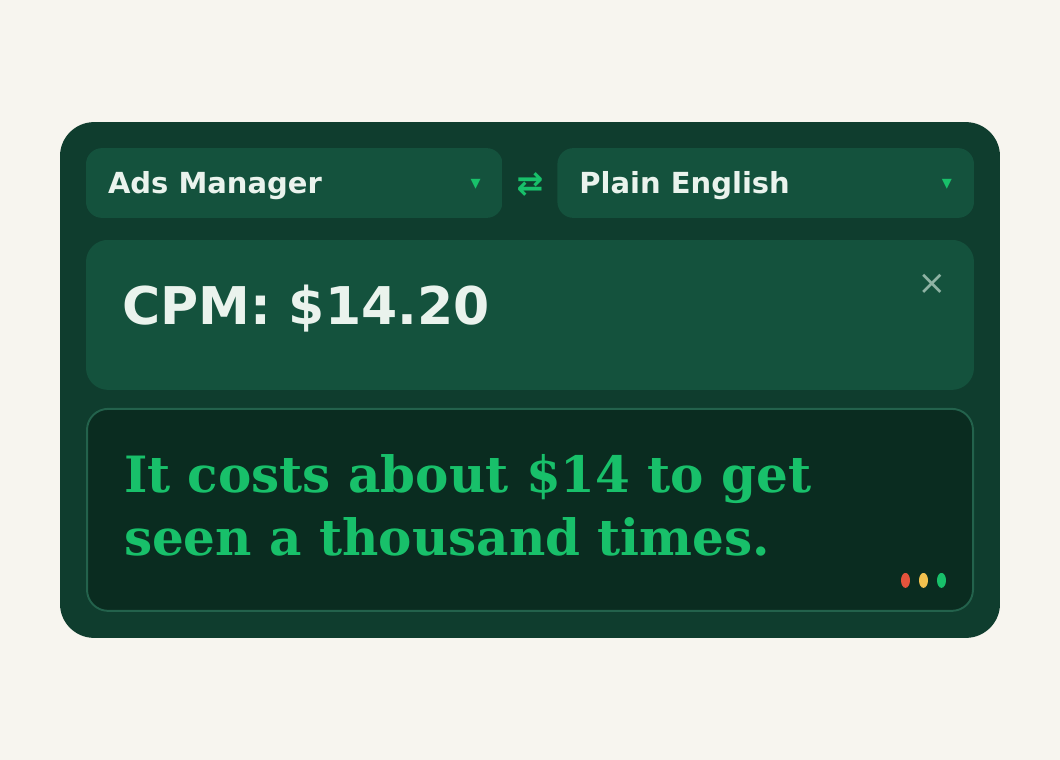
What it means: what it costs to show your ad a thousand times.
Why you'd care: it tells you how contested your audience is. If your CPM jumped, it usually doesn't mean you did something wrong. It means more advertisers are bidding for the same eyeballs. Holidays, election season, your entire industry launching at once.
The only benchmark that matters: your own last month. Anyone quoting you an industry average is guessing about your business.
CTR (click-through rate)
What it means: out of everyone who saw your ad, the percentage who tapped it.
Why you'd care: this is your creative's report card. Targeting problems and creative problems look similar from a distance, but a low CTR usually means the ad itself isn't landing, not that the wrong people saw it.
Rough read: under about 1% and I'd look hard at the creative before touching anything else.
Not sure where your account stands?
The 5-Minute Ad Audit gives you a red, yellow, or green light on the seven things that decide whether a budget works.
Take the auditFrequency
What it means: how many times the average person has seen this ad.
Why you'd care: this is the one people never check and should. Once you're past about three, you're increasingly paying to irritate people who already made up their mind.
What to do: new creative, or a bigger audience. Not a bigger budget.
Learning limited
What it means: this ad set isn't getting enough conversions for Meta to figure out who your buyer is.
Why you'd care: it's the single most common reason small accounts conclude that "ads don't work." Nothing is broken. It's underfed.
What causes it: almost always one budget split across too many ad sets. Six ad sets at $100 each will all stay confused forever. One ad set at $600 gets smart.
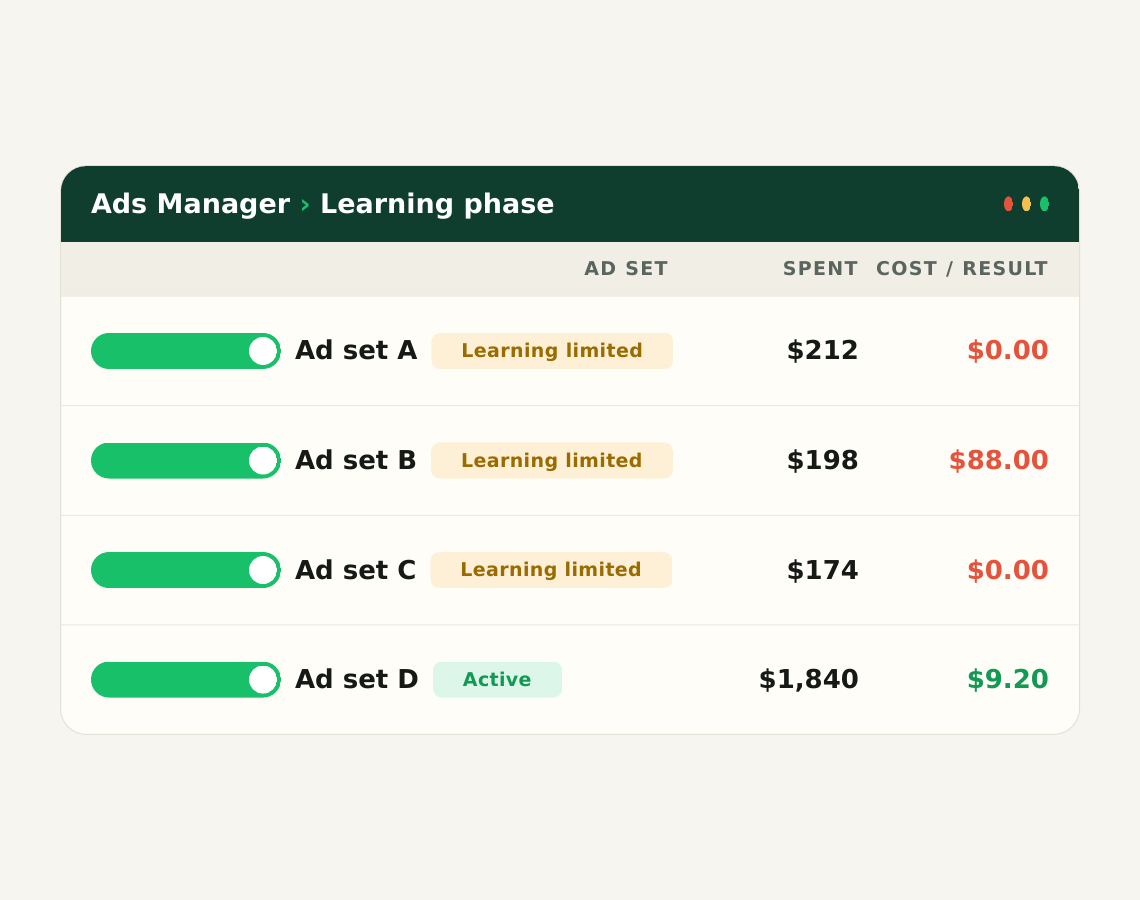
You want one ad set that learned something, not six that never got the chance.
Cost per result
What it means: what you paid for one of whatever you asked for. A lead, a purchase, a booking.
Why you'd care: this is the number. If you only ever look at one thing, look at this.
How to judge it: compare it to what a customer is worth to you. Lower? Spend more. Higher? Fix something before you spend more. That's genuinely the whole decision.
ROAS
What it means: return on ad spend. Revenue divided by what you spent.
Why you'd care: 1.8 means you made $1.80 for every dollar. Whether that's good depends entirely on your margins, which is why a "good ROAS" number quoted without context is meaningless.
Reach and impressions
What they mean: reach is how many people saw it. Impressions is how many times it was shown, including repeats.
Why you'd care: mostly you wouldn't. These are the metrics that feel best and pay the least. A million impressions and no sales is an expensive way to be seen.
Things you can safely ignore
Estimated ad recall lift. Post engagement, unless engagement is your actual goal. Page likes. Anything with the word "estimated" in front of it that you can't tie to money.
The rule underneath all of it
If a number doesn't change what you'd do next, it isn't a metric. It's decoration.
Most ad dashboards are ninety percent decoration, which is by design, because a busy dashboard feels like value. Pick the three numbers that would actually change your decisions and ignore the rest with confidence.